Ontario, CA · Garage Door Service
Garage Door Opener Repair, Ontario, CA
Opener failing or won't respond in Ontario? We repair broken garage door openers on homes built 1957-2007, with fast service across Ontario and nearby areas.
- Repairs & new doors
- Springs & openers
- Serving 6 nearby communities
Time on the Job
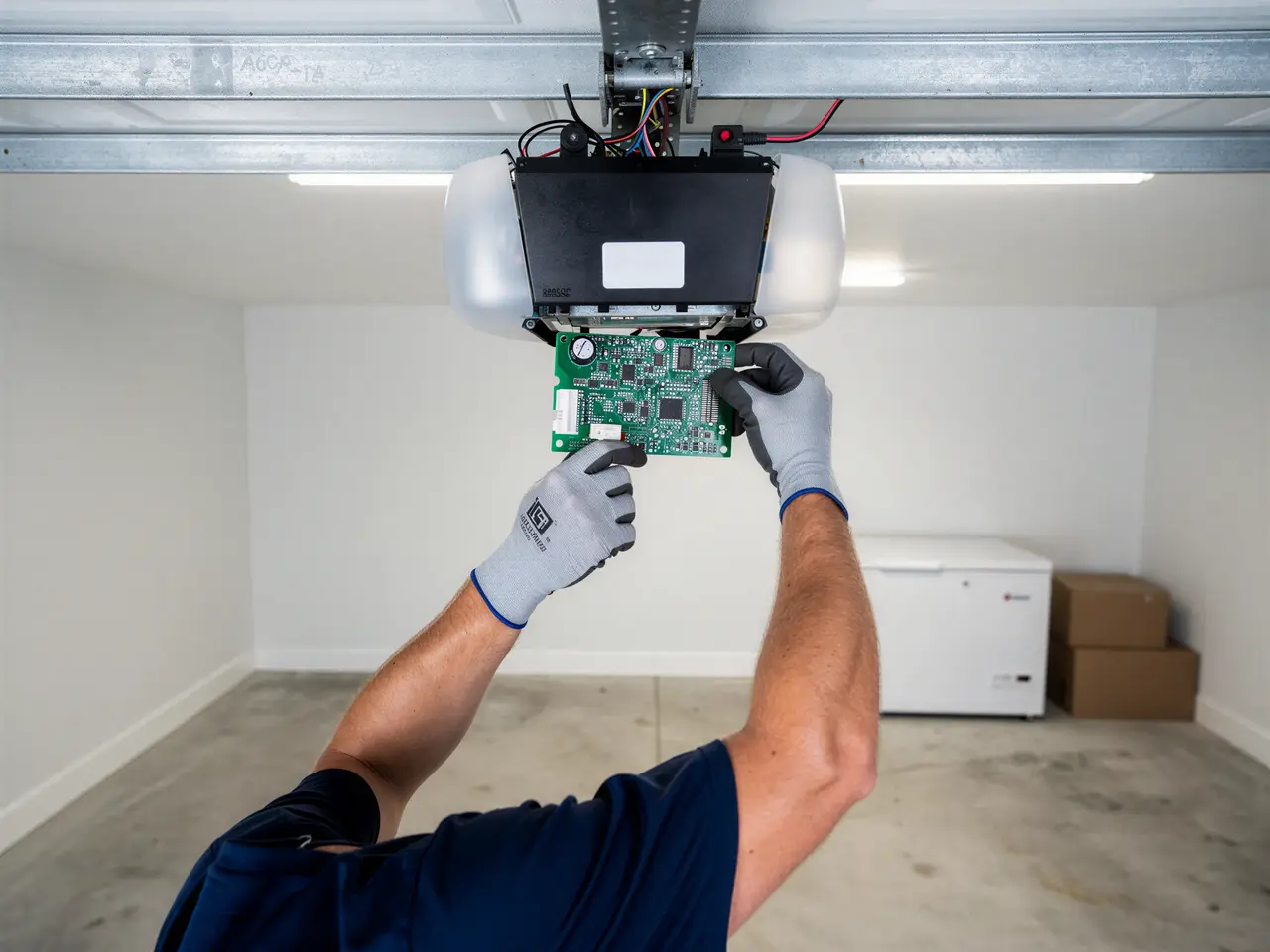
Opener calls in Ontario usually break down into two kinds of jobs: a quick fix and a full swap. A quick fix is a dead remote, a misaligned safety sensor, or a logic board that's lost its mind and needs a reset or a new circuit board. We can usually sort that on the first visit. A full swap is a motor that's burned out, a gear set that's stripped, or a unit so old that parts for it stopped shipping years ago - at that point we're not chasing a repair, we're putting in a new opener.
What we won't do is spend an hour troubleshooting a unit that's cheaper to replace than to fix. If your opener is a chain-drive from the original build era of your house and the motor's gone, we'll tell you straight that a new belt-drive unit makes more sense than hunting for a discontinued gearbox. That's not us upselling - it's the math of parts availability versus labor.
For jobs that are a straight swap, most of the time on site goes into mounting the new motor head, running the travel limits, and testing the safety reverse - not into diagnosis. For jobs that are a repair, diagnosis is most of the visit, because a dead opener can be the motor, the board, the sensors, or the wall switch, and they all look the same from the kitchen doorway.
Why It Happens Here
Housing in the Ontario service area went up mostly between 1957 and 2007, with the median home built around 1976. That puts a lot of garage openers on their second or third motor already, running on hardware designed for a chain-drive era that most manufacturers have since moved past. Across the roughly 30 named areas that make up this stretch of the Inland Empire, the bulk of the stock is 1960s-70s construction, which means original garage structures with openers retrofitted on-site rather than installed new.
The climate here sits in a moderate heat band, not the extreme swings you get further out in the desert, but garages still run hot enough through the summer to bake the lubricant out of a drive gear and stress the plastic housings that most openers depend on for the final gear reduction. An opener that's fine in a conditioned space can start skipping or grinding in a garage that spends months above 90 degrees, especially once the grease has gone dry.
Put those two things together - an aging installed base from the 1970s building boom and a climate that shortens the life of plastic and lubricant - and you get a service area where opener failure isn't random. It's a function of age and heat, concentrated in the same housing stock that makes up most of this region.
What You Are Seeing
A few patterns show up over and over on these calls. The door won't respond to the remote or the wall button at all - usually a dead capacitor, a tripped circuit, or a board that's failed outright. The door starts to open, then reverses and goes back down - almost always the safety sensors, either knocked out of alignment or blocked, though on an older chain-drive unit it can also be a worn limit switch.
Grinding or a loud pop right before the door stalls usually means a stripped gear inside the motor head - common on units running past their expected service life, and more common here given how much of the opener stock dates to the original building era of these neighborhoods. A door that opens fine but closes slow, or closes and then creeps back open, points to the opener's force settings drifting out of range, sometimes because a spring or cable elsewhere in the system is compensating for wear and the opener's fighting it.
Lights flickering on the unit, a remote that works sometimes but not always, or a wall button that needs three presses before anything happens - these are usually board or wiring issues rather than mechanical ones, and they tend to get worse, not better, left alone.
Doing It Yourself
Before you call anyone, check the obvious: is the opener plugged in, has a breaker tripped, and are the two safety sensors at the bottom of the track lined up with their little lights steady instead of blinking. A knocked sensor is the single most common reason a door won't close, and it's a two-minute fix with no tools.
If the remote's dead, swap the battery before you assume the opener's at fault. If the wall button doesn't work either, the problem is past the remote. Check your owner's manual for a reset sequence - most openers have one, and it clears out glitches that mimic a bigger failure.
What you shouldn't do yourself is open the motor housing to get at the gears, or adjust the force and travel settings by trial and error on a unit you don't know well. Those settings interact with the spring tension on the door itself, and getting them wrong can put real strain on a cable or send the door down harder than it should. If the sensors are aligned, the breaker's fine, and the remote has a good battery, and it still won't run - that's a board or motor problem, and that's where DIY stops being worth the risk to your hands or the door.
Frequently asked questions
Why does my garage door opener only work sometimes?
Intermittent response is usually a wiring or board issue rather than something mechanical. On openers from the 1970s-80s building era that make up a lot of the housing stock here, heat-stressed solder joints and worn relay contacts are common culprits. It can also be a remote losing its signal range as its battery ages, so check that first before assuming the board's failing.
Is it worth repairing an opener from the original house, or should I replace it?
Depends on what's failed. A sensor, a remote, or a logic board is worth fixing. A stripped gear set or burned motor on a chain-drive unit from the original build era usually isn't, because parts for those motors are hard to get and a new belt-drive unit costs about the same as sourcing discontinued parts.
Does the heat really affect the opener, not just the door?
Yes. Ontario sits in a moderate heat band, and garages here run well above outdoor temperature in summer. That heat dries out the grease in the opener's gear drive and stresses the plastic gear housing, which is a common reason openers start grinding or skipping after years of otherwise normal use.
By Neighborhood
Opener Repair across the Ontario area
We also handle opener repair in these Ontario-area suburbs.
Book garage door service in Ontario
Call now or request a quote - tell us what the door is doing and where you are.