
Ontario, CA · Garage Door Service
Garage Door Service for Ontario Homes, Built Different Decades, Breaking the Same Way
Ontario Garage Door Pros services the torsion springs, rollers, and openers common on homes built from the 1960s through the 1990s across Ontario and nearby areas.
- Repairs & new doors
- Springs & openers
- Serving 6 nearby communities
Time on the Job
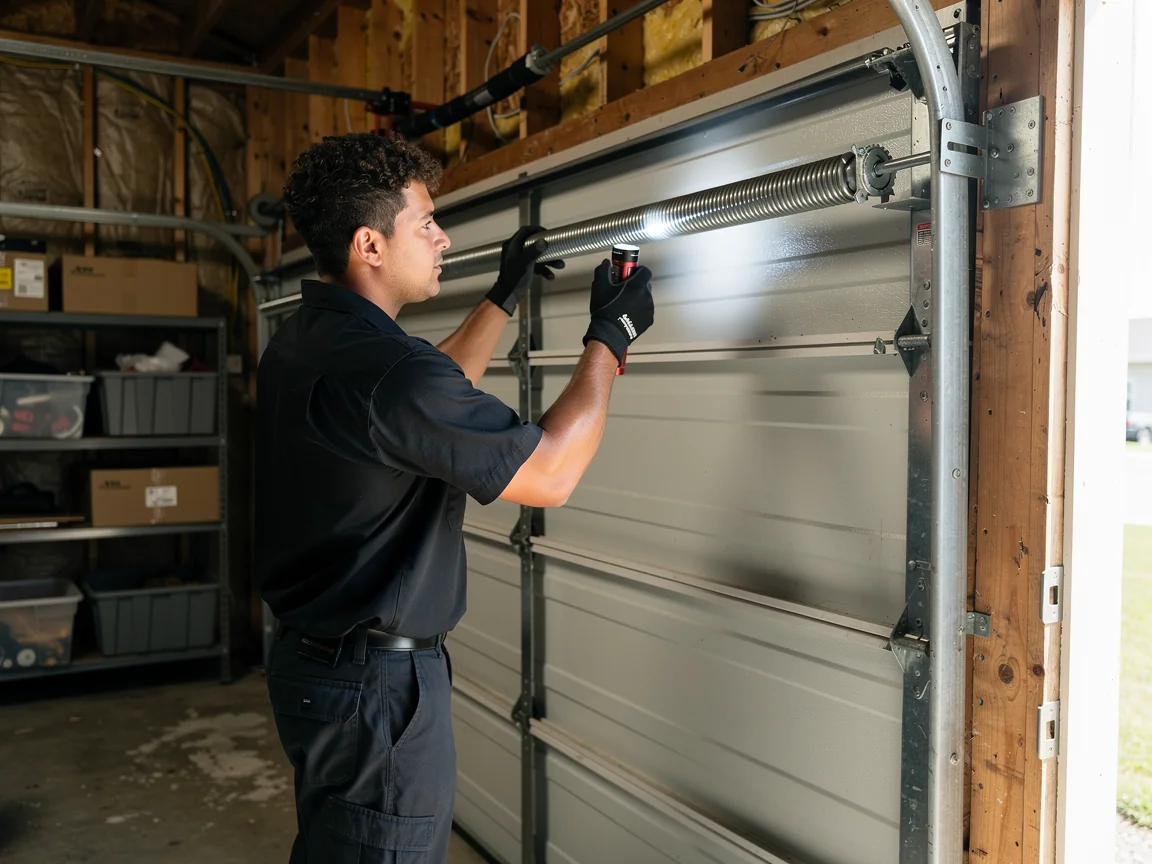
We work on doors across Ontario and the surrounding service area - Eastvale, Montclair, Jurupa Valley, Ontario Ranch, and the rest of the 30 communities we cover. Most of the calls we get aren't random. They follow the age of the house. A big share of the housing stock here went up between 1957 and 2007, with the median landing around 1976, and a lot of neighborhoods are still running the 1960s and '70s stock they started with. That means a door's original torsion spring, if it's never been swapped, is well past the cycle count it was rated for. We see openers from three different manufacturing eras on the same street, because remodels and replacements happened one house at a time, not block by block. On a service call we're not guessing at what decade of hardware we'll find - we're usually right the first time, because the build year tells us most of it before we open the panel.
Why It Happens Here
Heat here runs moderate rather than extreme, but it's still enough to matter on a door that's thirty, forty, even fifty years old. Steel tracks expand and contract with the daily swing, and on original hardware the fasteners have had decades of that cycle to work loose. Add in the sheer number of owner-occupied houses in this market - the service area has roughly 175,000 of them against 346,000 total households - and you get a lot of doors that get used twice a day, every day, by people who never think about the spring until it snaps. We don't see hurricane damage or snow-load failures here. What we see is fatigue: galvanized coating worn through on a cable, a center bearing plate that's rattled loose, a roller track bent slightly out of true from years of thermal movement. None of it is dramatic. It's just time, applied evenly, to hardware that was never meant to last this long.
What You Are Seeing
If your door is from that mid-century-to-1990s wave, the warning signs tend to repeat: a loud bang followed by the door refusing to lift (classic broken torsion spring), a door that reverses halfway up, or an opener that runs but the door barely moves - usually a cable off the drum or a spring that's lost enough tension to matter. On older galvanized springs, you'll sometimes see the coating flaking before the spring itself fails. On nylon rollers past their life, you get a grinding or clicking sound at a specific point in the track rather than the whole way up. We also still run into older chain-drive openers in this area that are simply at the end of their service life - not broken outright, just slow, loud, and inconsistent on the safety reverse. That's a judgment call worth having in person, since replacing the opener sometimes makes more sense than chasing one more repair.
Doing It Yourself
Lubricating hinges and rollers with a garage-door-specific spray, checking that the track bolts are snug, and testing the auto-reverse by placing a 2x4 flat on the ground under the door - these are fine to do yourself and worth doing twice a year. What you shouldn't touch is the torsion spring system. It's under enough stored tension to cause serious injury, and it's genuinely not a DIY repair regardless of how many videos make it look simple. We also won't pretend every job is urgent - if your door is functioning but noisy, it can usually wait for a scheduled visit rather than an emergency call. Where we draw an honest line: if the springs are original to a house built in the 1960s or '70s, we'll tell you straight that replacement of the full spring set is the right call, not a patch job on one side while the other is just as worn.
Frequently asked questions
How do I know if my garage door spring is actually broken or just needs adjustment?
If the door won't budge, or the opener struggles and reverses, and you hear a loud bang at some point (even days earlier), that's almost always a broken torsion spring. A spring that's just losing tension tends to show up gradually - the door gets heavier to lift by hand over weeks, not all at once.
Why does my opener from the 1980s still work but feel unreliable?
Chain-drive openers from that era were built solidly, but the safety reverse systems, logic boards, and drive gears weren't designed for forty-plus years of daily cycles. It'll often run, just inconsistently - which is actually a worse sign than it dying outright, since the safety features may not be reliable anymore.
Is it worth repairing an original door from a 1970s Ontario-area house?
Depends on what's failing. A spring, cable, or roller replacement on sound door panels is usually worth it. If the panels themselves are dented, rusted through, or warped, replacement often costs about the same as a string of repairs and gets you a door built to current hardware standards.
By Neighborhood
Garage Door Service across the Ontario area
We also handle garage door service in these Ontario-area suburbs.
Book garage door service in Ontario
Call now or request a quote - tell us what the door is doing and where you are.